
The Bluetooth book · second edition
It won't pair.
It sends garbage.
It won't talk to your iPhone.
Every way an Arduino Bluetooth link fails, why it fails, and the fix — for HC-05, HC-06, HM-10, the clones sold under all three names, and the ESP32.
A 277-page colour PDF and an EPUB, in five parts. Written to be opened in the middle, at the moment something stopped working.
Bought the first edition? Your order page now has the second. What changed
Start from the symptom
It opens on what is actually wrong
Most books make you read from the start. This one has a symptom index, written in the words you would use to describe the problem — not the words an engineer would use to classify it. Find the line, go to the page, and you get the test that tells the causes apart, then the fix, then the reason.
- →It never appears in my phone's Bluetooth list
- →It pairs, then drops after a few seconds
- →The Serial Monitor shows nothing but garbage
- →Uploading a sketch hangs forever
- →AT commands return ERROR, or nothing at all
- →It works on Android but my iPhone cannot see it
- →Half the AT commands in the tutorial do not exist on my module
- →The module got hot, and now it is dead
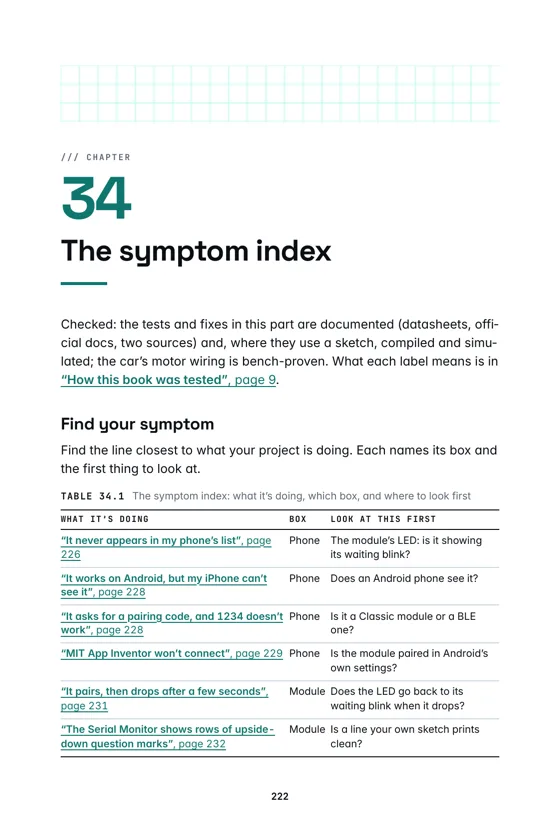
The index is on this site too, free — find what yours is doing →
Why this book exists
You may not own the module you think you own
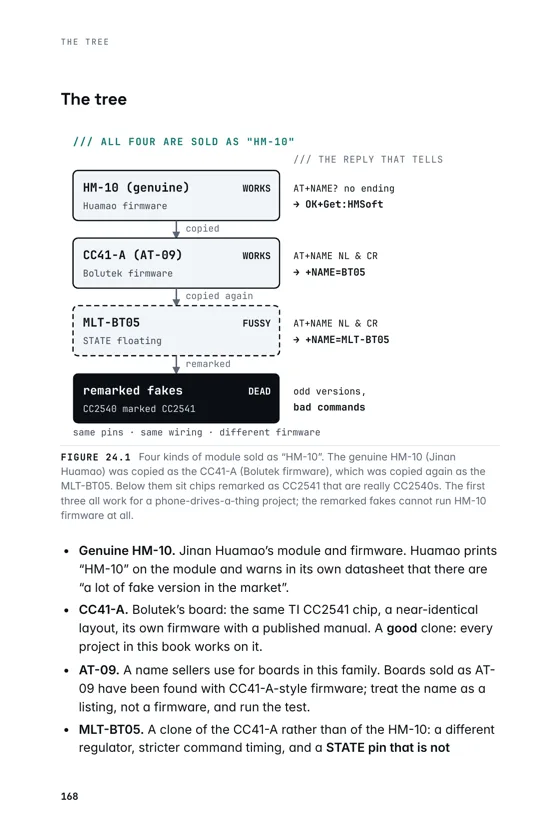
The HM-10 sells well, so it was copied — and then the copy was copied, and then the copy of the copy was faked. All of them are sold as "HM-10", often in the same listing, at the same price.
They take different AT commands. Follow a perfectly good tutorial with the wrong one in your hand and the first command you type returns nothing at all. The obvious conclusion is that you broke something. You did not.
Chapter 6 asks the module what it is before you change a setting, and chapter 24 draws the whole family, with the reply each one gives.
Inside
Five parts, 39 chapters
263 pages of content in the print edition. Part 1 is the core; the other four are there to open when you need them.
- 1Make it connect · Chapters 0–12One wiring that leaves the upload port free, one sketch that tests the link in both directions and doubles as an AT console, the three places a baud rate lives, how to find out which module you really bought, and a motor you drive from your phone. It ends with five worked faults and a short matrix.
- 2Serial in depth · Chapters 13–20What a byte looks like on the wire, how much baud error is too much, voltage levels and brown-outs, SoftwareSerial, lost commands, parsing whole messages, what a car should do when the link drops, and BLE explained for people who wanted a serial port.
- 3Module reference · Chapters 21–27The HC-05, HC-06, HM-10, the clone family and the ESP32, each on pages you can open cold, plus which pins to use on a Nano, Mega or Leonardo.
- 4Projects · Chapters 28–33A car with a ready-made controller app, your own Android controller in MIT App Inventor, a web-page remote, data back to the phone, two Arduinos talking, and a low-voltage Bluetooth switch.
- 5The fix encyclopedia · Chapters 34–38A symptom index, then faults grouped by where they live: the phone, the module, the Arduino, or the thing that won’t move.
Plus a glossary, the answers to every chapter's questions, and every sketch printed complete and commented.
Inside the pages
Real pages from the book
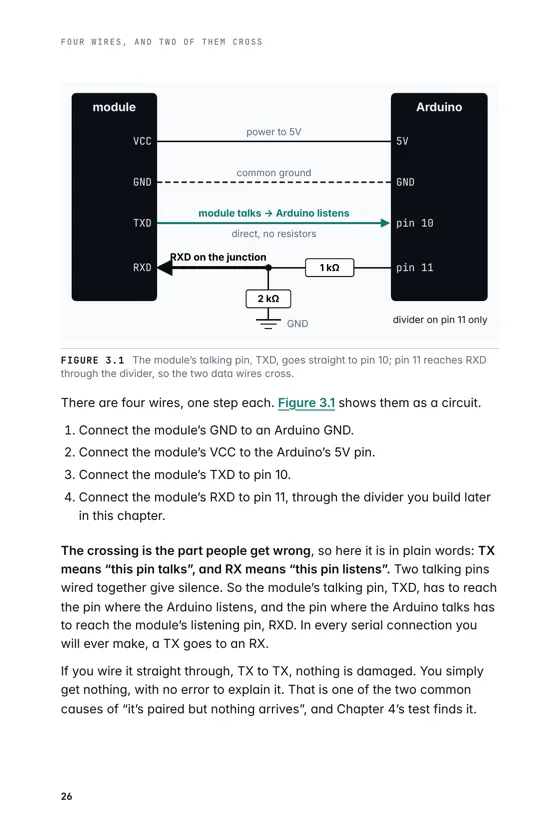
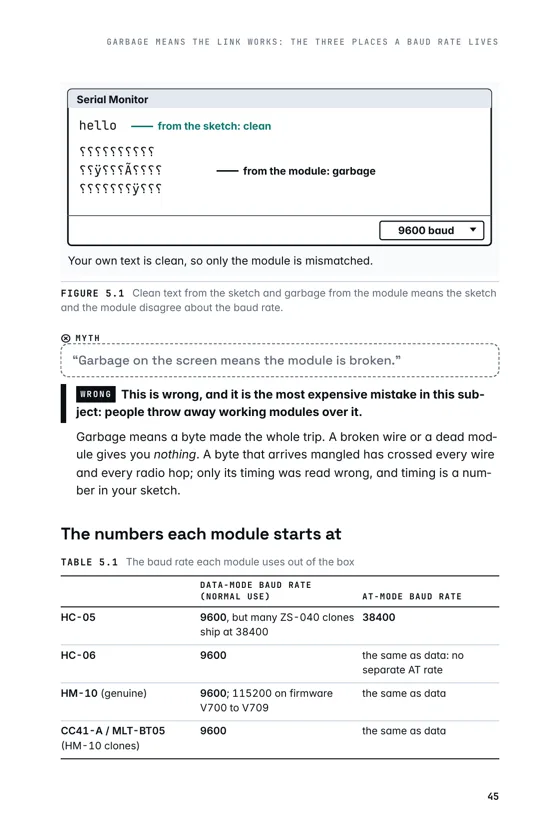
These are pages of the PDF you get, not mock-ups. Every figure is drawn from the circuit in code, so every wire ends on the right pin.
How far you can trust a page
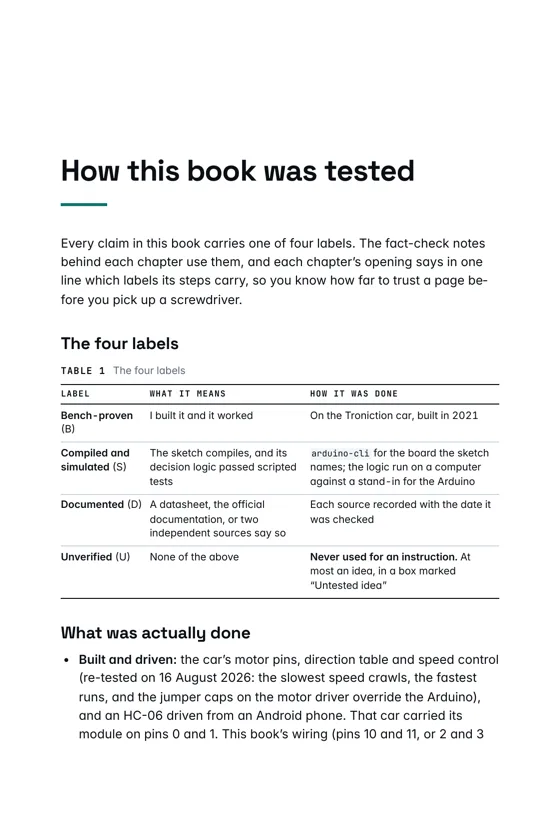
How this book was tested
Every claim in the book carries one of three labels, and each chapter says which ones its steps rest on:
- Bench-proven. I built it and it worked: the car's motor pins, direction table and speed control, and an HC-06 driven from an Android phone.
- Compiled and simulated. The sketch compiles for the board it names, and its logic passed scripted tests on a computer. This edition's wiring (pins 10 and 11, or 2 and 3 on the car) and the bridge test are here, not yet run on hardware.
- Documented. A datasheet, the official documentation, or two independent sources say so. That covers the HC-05, the HM-10, its clones and the ESP32, whose chapter uses Espressif's own examples.
Anything that is none of these is never written as a step. Facts that go out of date — browser support, free apps, prices — carry the date they were checked. The full page is page 9, and it is in the free sample.
Before you buy
The part most pages leave out
If you have an iPhone and an HC-05 or HC-06, no book can make them talk. iOS does not expose classic Bluetooth serial to apps at all — it is not a setting, an app, or a bug. You need a BLE module, and that is a purchase, not a fix.
And the "drive it from a web page, nothing to install" promise you will read elsewhere is real, but it is a Chrome and Android promise. Web Bluetooth has never shipped in Safari — no version, on any Apple platform — and Firefox does not have it either.
The book says all of this in chapter 10, with the browser table and the date it was checked. It is here too, because finding it out after paying is exactly the experience this book was written against.
The book
277-page PDF and EPUB, $15
One payment, yours to keep. Put the PDF on the desk next to the breadboard, search it when something breaks, and open it again in six months when you have forgotten which module you bought.
- · A 277-page colour PDF, laid out for reading on a screen
- · An EPUB of the same book, for an e-reader or phone
- · HC-05, HC-06, HM-10, the clones and the ESP32
- · Every claim labelled with how it was checked
- · Every sketch complete and commented
- · Dated — prices and browser support say when they were checked
Instant download. Kindle and print editions are not on sale yet.
The free sample
The first 30 pages: the contents, how to use the book, how it was tested, and the opening of Part 1 — the four boxes, choosing the module, and the start of the wiring. The actual first pages of the actual book, folios and all.
Questions
Straight answers
- Which module do I need?
- Chapter 2 is that decision. The short version: an HC-06 if your remote is an Android phone, an HM-10 if an iPhone is involved, an HC-05 if one Arduino has to call another.
- Will this work with my iPhone?
- Only with a BLE module, and the book says so plainly rather than at the end. Classic modules — HC-05 and HC-06 — are invisible to iOS at the operating-system level. No app fixes it. Chapter 10 covers what does.
- Do I need to solder?
- No. Every connection in the book is a plug-in wire or a screw terminal. You need two resistors, and they push into a breadboard.
- I already bought an HC-05. Is the book still useful?
- Yes — that is most readers. The book covers the HC-05, HC-06, HM-10 and the clone family together, because the whole problem is that tutorials assume one and you own another.
- I bought the first edition. Do I get this one?
- Yes. Your order page now has the second edition, PDF and EPUB, at no charge. Use the link in your receipt email.
- Which formats do I get?
- A 277-page colour PDF laid out for reading on a screen, and an EPUB of the same book for an e-reader or phone. Kindle and print editions are not on sale yet.
- Is this just the free tutorials collected?
- No, and it would not be worth $15 if it were. The free tutorials cover the happy path well. This covers what happens when the happy path does not happen — and the clone family, which few sources cover at all.
- What if it does not help?
- Ask for your money back within 30 days and keep the book. There is no version of this where arguing over $15 is worth either of our time.
Building with a child rather than debugging your own project? The free car book is the same hardware written for a parent and a child of twelve or older, and assumes none of this one.
Corrections and updates
Which version you hold, and what changed
The version number is on the copyright page (page 2). When I correct or extend the book, the change is listed here with its date.
- 2026-10-01Version 2.0.1.Every digit is a moving speed, and only S stops. The PDF is now 277 pages.
- 2026-10-01Second edition (version 2.0.0) replaced the first.39 chapters in five parts, a PDF plus an EPUB, replacing the first edition’s 62-page PDF. It also carries the first edition’s corrections: the HC-05 command-mode baud rate set in the sketch, not in the Serial Monitor; the car’s module on pins 2 and 3; halt() in the command listing. If you bought the first edition, your order page now has the second.
- 2026-08-19First edition (version 1.0.0) published.62 pages, PDF only.
Found a mistake?
Tell me which page, what you did, and what you saw. Corrections go into the next version and onto this list.
Opens an email to [email protected].
Or go further
The same book, with the build
This book diagnoses. If you would rather end up with something that drives, the same book comes paired with an eight-lesson course that builds a car you steer from your phone — wiring figures, every sketch compiled before it shipped, and a parts list with real prices. It is graded, with quizzes, a final exam and a certificate you can link to.
The pair is $12 while the first 100 last, and $24 after. Yes, while the launch price lasts that is less than this book on its own.